The Comm Guild
Saturday Dec 25, 2021
Maelstrom's Edge 2021 Christmas Special!
 - by Iain Wilson
It's become a bit of a tradition around this time of year for me to grab some leftover sprues and throw together a sci-fi Christmas tree ornament. For this year's trinket, I grabbed some parts from the original Maelstrom's Edge terrain sprue and made myself a somewhat technological snowflake!

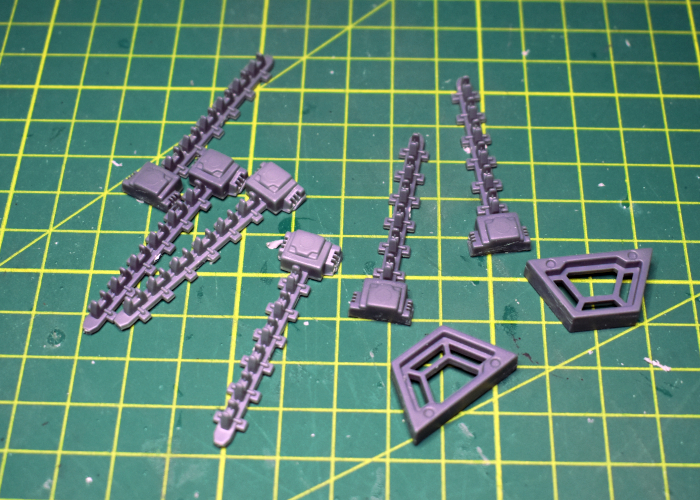
The build for this one was pretty simple. I started out with two trapezoid windows and half a dozen energy fence pylons.
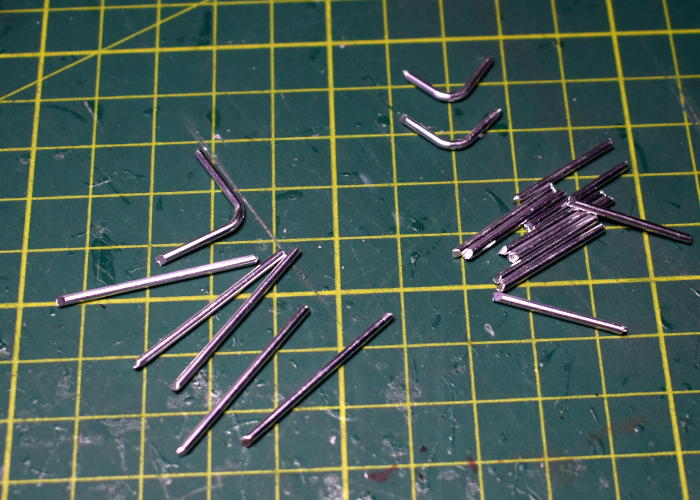
To make the branching parts of the snowflake 'arms', I grabbed some 1.5mm aluminium rod, cut it into 20mm and 30mm lengths, and bent them in the middle.
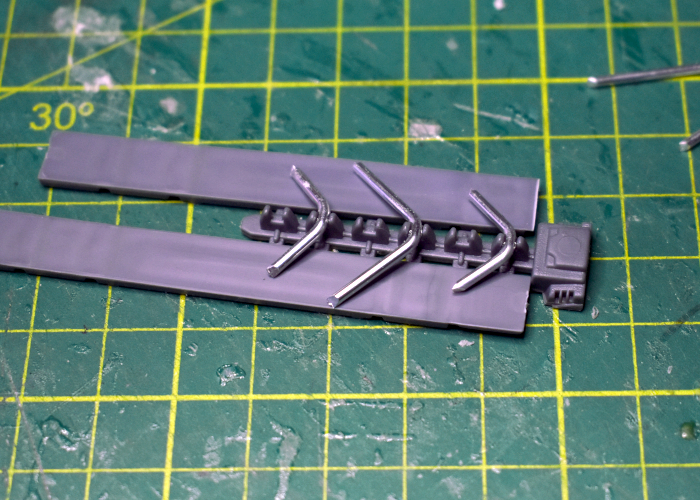
I made a simple formwork to glue the rod pieces in place, by laying a pair of struts from the terrain sprue on either side of the fence posts, adding a drop of glue into the grabby port on the post, and then sitting the bent rod in place. Another dollop of glue on top sealed the rods in place. I also added another piece of rod bent into a loop on the end of the 'top' fence post, to serve as a hanging loop.
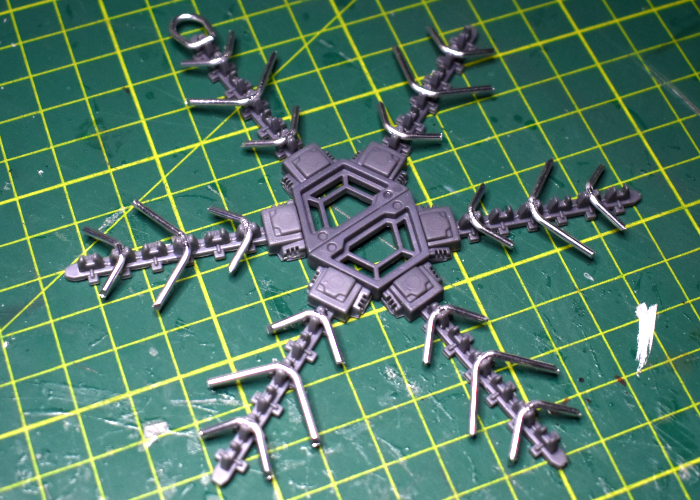
Once the frankly horrific amount of glue I had used here had time to set, I used plastic cement to glue the windows together, and the bottoms of the fence posts to the window frames.
On to painting! I sprayed the whole thing with Army Painter Matt Black, and then with a layer of Plate Metal.
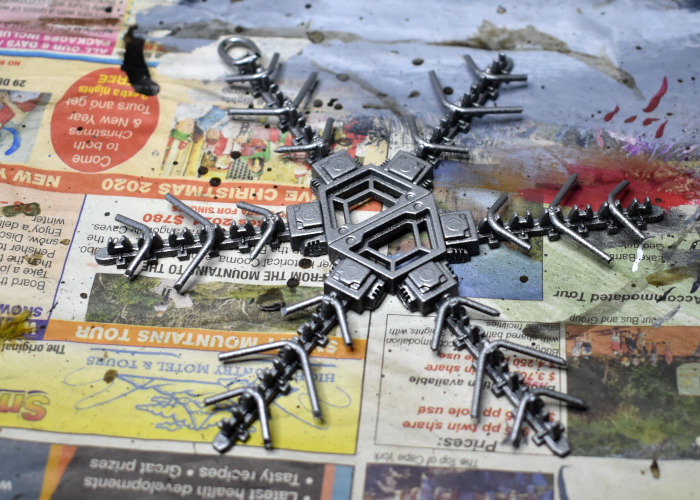
I then went over the window frams and fence posts with some Secret Weapon Soft Body Black wash that I had sitting around from an Adepticon goodie bag a few years back.
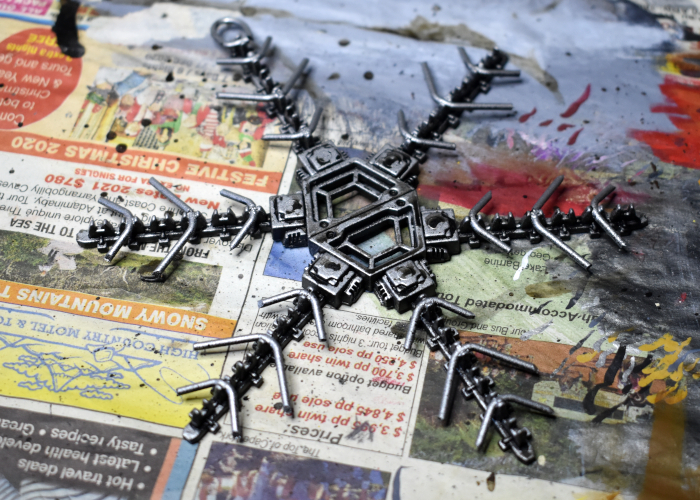
On the fence post bases and the window frames, I added a coat of Citadel Macragge Blue, with a highlight around the edges of Army Painter Ice Storm.
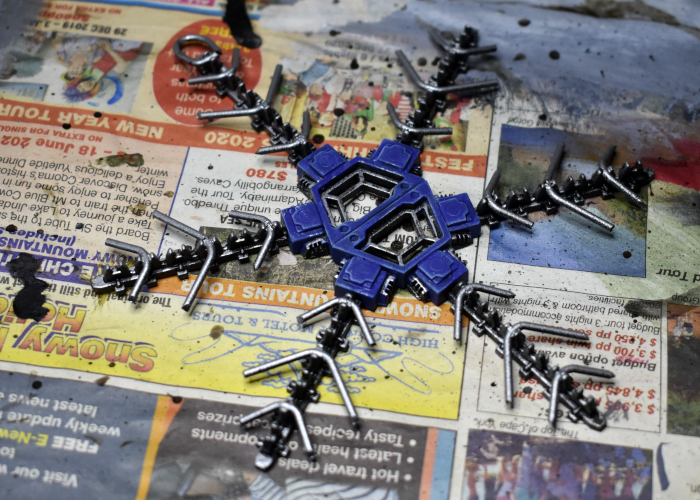
Then, because I apparently can't go for more than a week without weathering something, I took a sponge and some Vallejo Heavy Charcoal and added some chipping to the blue areas, highlighting with some more Ice Storm. As a final touch, I used some Army Painter blue tone to add a blue tint in the creases of the 'arm' attachments, for a little extra colour. And then on to the tree it went!
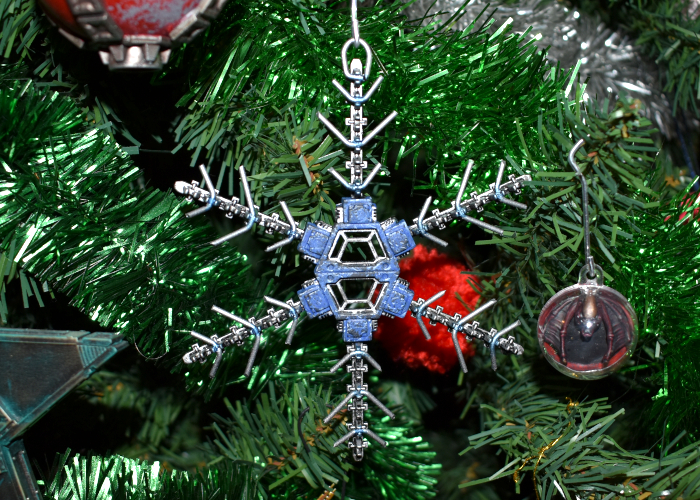
Here's wishing everyone a safe and happy time for whatever holidays you happen to celebrate around this time of year!
Build your own ornament of celebratory doom by picking up the Maelstrom's Edge terrain sprues along with the rest of the Maelstrom's Edge range from the webstore here.
What are you working on? We would love to see your models and terrain in the Comm Guild Facebook group!
For other building ideas, modeling tutorials, army spotlights and conversion walkthroughs, check out the Hobby section of the Maelstrom's Edge website here.
Posted at 06:00pm Dec 25, 2021 by insaniak in Tutorials |
Monday Dec 20, 2021
Maelstrom's Edge V2 Beta Rules released!
The 2nd edition of the Maelstrom’s Edge rulebook is on its way, and we're offering a sneak preview in the form of a downloadable Beta version of the rules. You can find the link at the end of this article, but you’re probably wondering: what’s changed? Is it a totally new game or just a sprucing up of the v1 rules? The answer is: a little bit of both.
If you’re a big fan of the v1 rules, then you’ll be pleased to know that the core pillars that comprise Maelstrom’s Edge are not only still there, but have been strengthened. It’s still an alternating activation, squad-based “skirmish” game (aka focused on small squads of 1-6 models) that features 6-sided dice (D6), multi-tiered mission objectives, a suppression mechanic, the ability to bring back destroyed units as reinforcements and a regenerating command point system that can be used for a variety of tactical functions.
If, on the other hand, you’re someone that liked the overall concept of the original Maelstrom’s Edge rules, but you thought that the rules were a little too fiddly, then we also have great news for you! The v2 rules have been totally re-written and highly streamlined: they are a good 30% shorter than the v1 rules as a result. While the v2 rules are undeniably simpler, they’ve also gotten more complex where it counts: giving you tons of new tactical decisions to make with your units during the game. On top of that, the dice rolling “engine” now feels really fresh: each round of shooting keeps both players involved rolling dice and utilizes a “dice flip” mechanic that adds an element of bad luck protection right into the core of the game.
Let’s run through some highlights of the major v2 changes:
SIMPLIFIED UNIT ACTIONS
The largest change in v2 is how unit actions work. The activation test is gone and a unit can now perform up to 3 actions, selected from: movement actions (Move, Dash, Charge), status actions (Aim, On the Move, Take Cover) and shooting actions (Fire, Suppressive Fire, CQ Fighting). While there are some additional caveats to this system (a unit can perform a maximum of only 1 movement and 1 shooting action per activation, for example), we’ve found during playtesting that by splitting the action rules into these smaller “bite-sized” chunks, it makes the whole system much easier to remember. In addition, decoupling movement, shooting and status rules from each other now gives players several new combinations of what to do with their units when they activate them.
SUPPRESSION THAT MATTERS
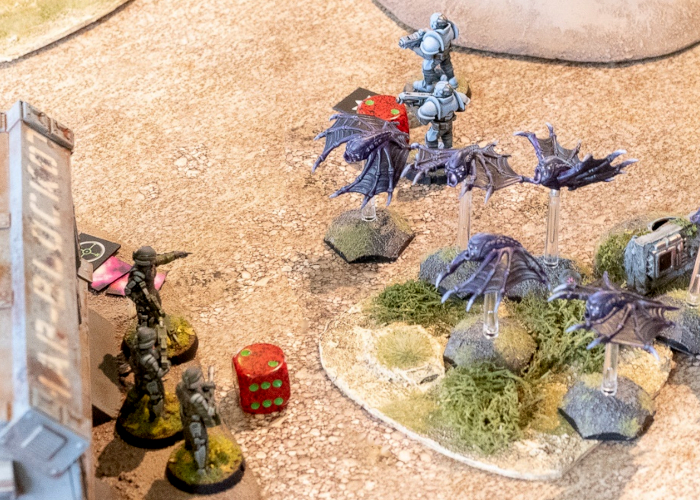
In v2, suppression is both much simplified and also a whole heck of a lot more deadly. Instead of utilizing tons of suppression tokens, each unit only has 6 suppression levels (which can be conveniently tracked with a D6 next to the unit). Not only does suppression still degrade a unit’s shooting and their ability to benefit from cover, but each time a unit already at max suppression is called upon to raise their suppression level again, one model in the unit instead suffers an injury (which is fatal for most standard infantry in the game). This means it is now entirely possible to ”suppress” an enemy unit to death, representing them fleeing from the battlefield due to the hail of firepower coming their way. This makes the new Suppressive Fire action (which trades-in a shooting unit’s ability to cause damage for a boosted ability to cause suppression) a deadly tool in certain situations.
A NEW DICE ENGINE
The new dice rolling engine in v2 is quite unique, but still based exclusively on 6-sided dice that most players prefer. It is both simple enough to quickly understand, yet nuanced enough to offer: built-in bad luck protection, having both players involved with each round of shooting and tactical player choice within the dice rolling process. Most importantly, when units shoot at each other, the amount of damage they cause now just feels right.
So how does the new system work? As a firing player, all you have to do is look to equal or beat the target’s Evasion characteristic (EVS) with your D6 rolls. For example, if the target has an EVS 4 (the standard EVS of most infantry units), you’d need results of 4-6 to successfully hit them. In addition, as the firing player you get to influence these results by making a number of “dice flips” (changing the result of rolls in your favor) up to the Skill characteristic (SKL) of your firing unit. For example, if your firing unit was SKL 3, you could add +3 to a single roll, +1 to 3 different rolls, or anywhere else in between. Where things really get interesting is that results of ‘1’ and ‘6’ are “critical” results. A “critical hit” (a hit roll result of ‘6’) provides that shot with extra lethality. But it also takes 2 dice flips to change a non-critical result into a critical result (a ‘5’ result into a ‘6’). This means sometimes you have to decide whether using 2 dice flips to change a single ‘5’ result into a critical hit will be more beneficial than just using those same dice flips to score two more standard hits.
And of course, once the firing player has determined how many hits they’ve scored on the target, the defending player gets to make an armor roll against each hit, looking to equal or exceed the Penetration characteristic (PEN) of the firing weapon. Similarly, the defending player gets to influence the results of these rolls with a number of dice flips equal to the Armor characteristic (AV) of their models.
FEWER SPECIAL RULES
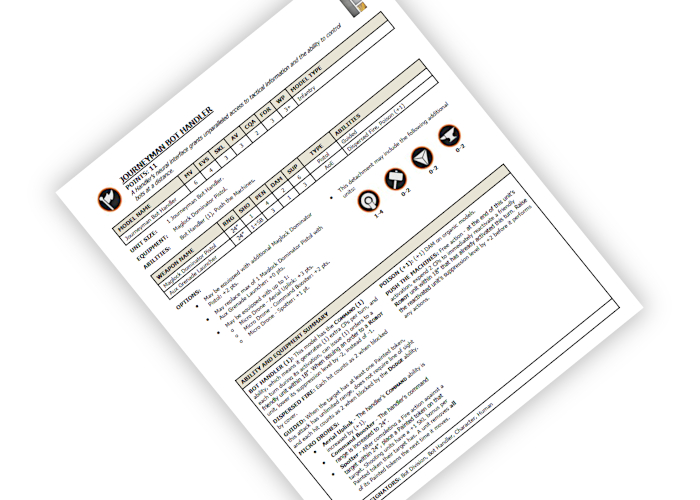
With v2, we’ve realized that adding back a few more characteristics to the model/weapon profile means a big reduction in the amount of special abilities in the game. Plus, the abilities we have kept have been greatly simplified, all with the end goal of making each unit’s full rules (including all the text for their unit and weapon abilities) fit onto just a single page.
Here’s a quick rundown of the “new” model & weapon characteristics in v2:
MORE LETHALITY
One goal of the v2 rules has been to improve the level of lethality in the game. Allowing massive amounts of suppression to inflict damage to a unit was a good first step, but the real key to this change has been the removal of the Mass characteristic (MAS) from the model profile. Now, each point of damage a model suffers just reduces their Fortitude (FOR) characteristic by 1 (and when a model reaches 0 FOR, it is a casualty). The vast majority of standard infantry models only have FOR 1, which means that any hit which gets through their armor will cause a casualty. While this doesn’t suddenly mean that models are now dying in droves in v2, we can safely say that you will notice and appreciate the increase in lethality in the game. You’ll definitely want to start using the reinforcement rules more often to bring back your destroyed units!
QUALITY OF LIFE IMPROVEMENTS
The v2 rules are chock full of little improvements that make the game feel way better overall. Here’s a taste of them:
IN CONCLUSION
As you can see, the new rules for Maelstrom’s Edge are chock full of improvements...and none of what we’ve presented above even covers the massive rules re-work we’ve done for every single unit in the game. Their rules are both far more streamlined but also laser-focused on allowing them to perform exactly how they’re supposed to. It’s been an extremely long time coming, but we can’t wait for you to try out the new rules and let us know what you think!
The new rulebook will be coming along (hopefully!) in the first half of 2022, but you can get a headstart on the V2 ruleset by downloading a Beta version of the rules here. The Beta rules documents contains all of the rules for playing the game, but keep in mind that these are just 'preview' documents - some rules may be revised based on feedback, and the final layout including background material for the factions and the Maelstrom's Edge universe, artwork and other 'flavor' material is missing.
If you have any thoughts on the new rules, you can pop on over to the Comm Guild Facebook group, or start up a thread in the Maelstrom's Edge section on the Dakka Dakka forums. We welcome any feedback, and would love to hear how everyone's forces stack up in the new rules!
If you’re a big fan of the v1 rules, then you’ll be pleased to know that the core pillars that comprise Maelstrom’s Edge are not only still there, but have been strengthened. It’s still an alternating activation, squad-based “skirmish” game (aka focused on small squads of 1-6 models) that features 6-sided dice (D6), multi-tiered mission objectives, a suppression mechanic, the ability to bring back destroyed units as reinforcements and a regenerating command point system that can be used for a variety of tactical functions.
If, on the other hand, you’re someone that liked the overall concept of the original Maelstrom’s Edge rules, but you thought that the rules were a little too fiddly, then we also have great news for you! The v2 rules have been totally re-written and highly streamlined: they are a good 30% shorter than the v1 rules as a result. While the v2 rules are undeniably simpler, they’ve also gotten more complex where it counts: giving you tons of new tactical decisions to make with your units during the game. On top of that, the dice rolling “engine” now feels really fresh: each round of shooting keeps both players involved rolling dice and utilizes a “dice flip” mechanic that adds an element of bad luck protection right into the core of the game.
Let’s run through some highlights of the major v2 changes:
SIMPLIFIED UNIT ACTIONS
The largest change in v2 is how unit actions work. The activation test is gone and a unit can now perform up to 3 actions, selected from: movement actions (Move, Dash, Charge), status actions (Aim, On the Move, Take Cover) and shooting actions (Fire, Suppressive Fire, CQ Fighting). While there are some additional caveats to this system (a unit can perform a maximum of only 1 movement and 1 shooting action per activation, for example), we’ve found during playtesting that by splitting the action rules into these smaller “bite-sized” chunks, it makes the whole system much easier to remember. In addition, decoupling movement, shooting and status rules from each other now gives players several new combinations of what to do with their units when they activate them.
SUPPRESSION THAT MATTERS
In v2, suppression is both much simplified and also a whole heck of a lot more deadly. Instead of utilizing tons of suppression tokens, each unit only has 6 suppression levels (which can be conveniently tracked with a D6 next to the unit). Not only does suppression still degrade a unit’s shooting and their ability to benefit from cover, but each time a unit already at max suppression is called upon to raise their suppression level again, one model in the unit instead suffers an injury (which is fatal for most standard infantry in the game). This means it is now entirely possible to ”suppress” an enemy unit to death, representing them fleeing from the battlefield due to the hail of firepower coming their way. This makes the new Suppressive Fire action (which trades-in a shooting unit’s ability to cause damage for a boosted ability to cause suppression) a deadly tool in certain situations.
A NEW DICE ENGINE
The new dice rolling engine in v2 is quite unique, but still based exclusively on 6-sided dice that most players prefer. It is both simple enough to quickly understand, yet nuanced enough to offer: built-in bad luck protection, having both players involved with each round of shooting and tactical player choice within the dice rolling process. Most importantly, when units shoot at each other, the amount of damage they cause now just feels right.
So how does the new system work? As a firing player, all you have to do is look to equal or beat the target’s Evasion characteristic (EVS) with your D6 rolls. For example, if the target has an EVS 4 (the standard EVS of most infantry units), you’d need results of 4-6 to successfully hit them. In addition, as the firing player you get to influence these results by making a number of “dice flips” (changing the result of rolls in your favor) up to the Skill characteristic (SKL) of your firing unit. For example, if your firing unit was SKL 3, you could add +3 to a single roll, +1 to 3 different rolls, or anywhere else in between. Where things really get interesting is that results of ‘1’ and ‘6’ are “critical” results. A “critical hit” (a hit roll result of ‘6’) provides that shot with extra lethality. But it also takes 2 dice flips to change a non-critical result into a critical result (a ‘5’ result into a ‘6’). This means sometimes you have to decide whether using 2 dice flips to change a single ‘5’ result into a critical hit will be more beneficial than just using those same dice flips to score two more standard hits.
And of course, once the firing player has determined how many hits they’ve scored on the target, the defending player gets to make an armor roll against each hit, looking to equal or exceed the Penetration characteristic (PEN) of the firing weapon. Similarly, the defending player gets to influence the results of these rolls with a number of dice flips equal to the Armor characteristic (AV) of their models.
FEWER SPECIAL RULES
With v2, we’ve realized that adding back a few more characteristics to the model/weapon profile means a big reduction in the amount of special abilities in the game. Plus, the abilities we have kept have been greatly simplified, all with the end goal of making each unit’s full rules (including all the text for their unit and weapon abilities) fit onto just a single page.
Here’s a quick rundown of the “new” model & weapon characteristics in v2:
- The model profile has lost its Mass characteristic (MAS), but has gained the Close Quarters Attacks characteristic (CQA) instead, rectifying the biggest point of negative feedback we got about the v1 rules: the much maligned ‘formula’ that was necessary to determine how many melee shots a model was able to make.
- The weapon profile has gained a Suppression characteristic (SUP), which is utilized when the unit makes a Suppressive Fire action.
- The weapon profile has gained a Weapon Type characteristic (TYPE), which helps set apart the archetypal weapon rules (like “AoE”, “Heavy” or “Short Ranged”) from true weapon special abilities.
MORE LETHALITY
One goal of the v2 rules has been to improve the level of lethality in the game. Allowing massive amounts of suppression to inflict damage to a unit was a good first step, but the real key to this change has been the removal of the Mass characteristic (MAS) from the model profile. Now, each point of damage a model suffers just reduces their Fortitude (FOR) characteristic by 1 (and when a model reaches 0 FOR, it is a casualty). The vast majority of standard infantry models only have FOR 1, which means that any hit which gets through their armor will cause a casualty. While this doesn’t suddenly mean that models are now dying in droves in v2, we can safely say that you will notice and appreciate the increase in lethality in the game. You’ll definitely want to start using the reinforcement rules more often to bring back your destroyed units!
QUALITY OF LIFE IMPROVEMENTS
The v2 rules are chock full of little improvements that make the game feel way better overall. Here’s a taste of them:
- Command points no longer need to be allocated to command models. They just stay in your command point pool until you decide to use them.
- More command models have powerful abilities that cost command points to use, giving you further options for what to use your command points on (besides the mainstays of bringing back reinforcements and lowering suppression on your units). But don’t worry, we haven’t gone overboard and given every unit a Command Point based ability, these are still quite special.
- When moving your units, you now only have to bother measuring and moving the unit’s squad leader. The rest of the models are just placed in coherency (within 3” of the squad leader) after their squad leader has finished being moved. This dramatically speeds up the process of moving units.
- The v1 rules deliberately syphoned almost every non-damage effect down to just generating additional suppression, which made special abilities feel, well, not so special. With v2, we’ve expanded the range of what special abilities can do (and we’ll eventually be releasing a set of plastic tokens to help facilitate this). Be prepared to be able to set units on fire, slow them down, freeze them and confuse them, just to name a few options.
- To promote unit movement, defensive fire in v2 has been reduced to just protecting a unit from being charged or shot by a hit and run attack. This means units equipped with Short Ranged weaponry can finally shine, being able to run up to enemy units and blast them at point blank range without fear of being decimated first.
- The way mission objectives generate victory points (VPs) has been simplified, making it much easier to calculate how many VPs you’ve earned at the end of each turn. In addition, the margin you need to be ahead of your opponent to end the game immediately has been widened for all missions, now requiring a +5 VP margin. This gives a little more breathing room for close games to go the distance while still allowing for blowouts to end without one player having to bite the bullet and concede.
- There are now 18 types of mission objectives (up from 12) and 6 different deployment maps (up from 2). There are also now 12 competitive missions and 6 narrative missions included with the core rulebook (up from 6 & 0 respectively). All this means there is now a whole lot more mission variety in v2!
- There is a fun new objective marker placement rule forcing you to place objective markers in the opposing half of the table (and your opponent is bound by the same rule). This helps create tense, interesting games where both sides are fighting over objective markers clustered near the centerline of the table, as opposed to one player getting lucky and having one random objective marker near their deployment zone granting them an easy victory.
IN CONCLUSION
As you can see, the new rules for Maelstrom’s Edge are chock full of improvements...and none of what we’ve presented above even covers the massive rules re-work we’ve done for every single unit in the game. Their rules are both far more streamlined but also laser-focused on allowing them to perform exactly how they’re supposed to. It’s been an extremely long time coming, but we can’t wait for you to try out the new rules and let us know what you think!
The new rulebook will be coming along (hopefully!) in the first half of 2022, but you can get a headstart on the V2 ruleset by downloading a Beta version of the rules here. The Beta rules documents contains all of the rules for playing the game, but keep in mind that these are just 'preview' documents - some rules may be revised based on feedback, and the final layout including background material for the factions and the Maelstrom's Edge universe, artwork and other 'flavor' material is missing.
If you have any thoughts on the new rules, you can pop on over to the Comm Guild Facebook group, or start up a thread in the Maelstrom's Edge section on the Dakka Dakka forums. We welcome any feedback, and would love to hear how everyone's forces stack up in the new rules!
Posted at 06:00pm Dec 20, 2021 by insaniak in Gaming |
Tuesday Dec 14, 2021
It's the 2021 Roundup!
With another year almost come to an end, it seems like a good time to pause and look back at some highlights from the Maelstrom's Edge!
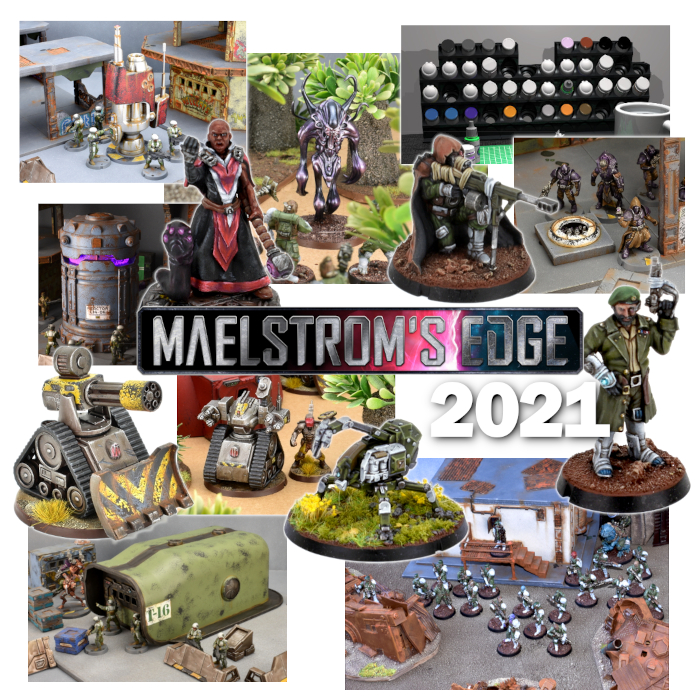
The Karist, Broken and Epirian factions all received some reinforcements this year. We also saw the end of the Battle for Zycanthus boxed set, as our existing stock sold out. With the second edition of the game on the horizon, rather than producing more of this set, we added some starter bundles and troop bundle deals for each faction to the Maelstrom's Edge webstore.
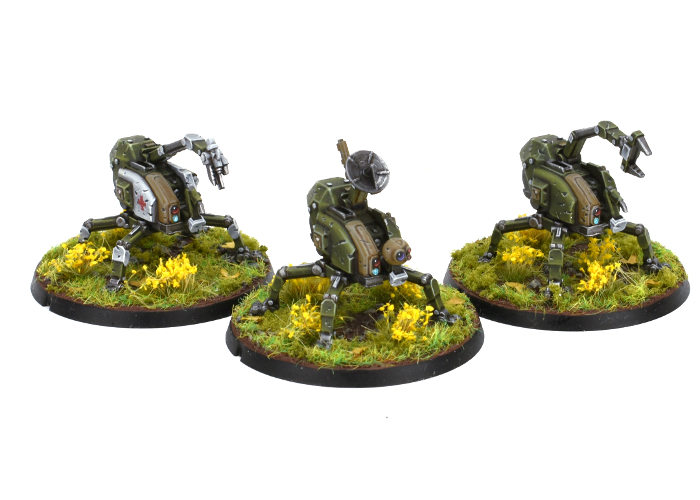
The Contractor Support Drone added some new equipment options to Epirian forces, allowing Contractors to field Engineer and Medic units and adding sensor drones to Contractor Scouts. This is the last full resin model to be released for Maelstrom's Edge as, with the exception of a couple of upcoming equipment options for the Artarian Remnant, we have now moved completely to plastic for our models.
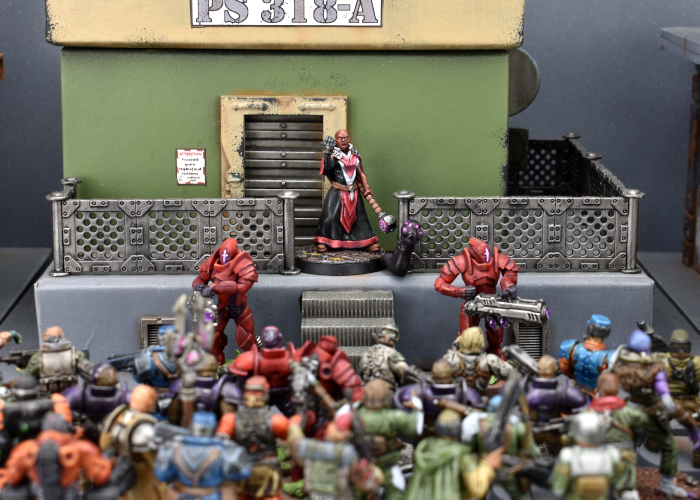
The Kaddar Alessi Novitiate serves as an alternate command option for Karist forces. Slightly less unhinged than the typical Kaddar Nova, Kaddar Alessi use their charisma and oratory prowess to inspire the forces under their command, or to shake the resolve of any enemy within earshot.
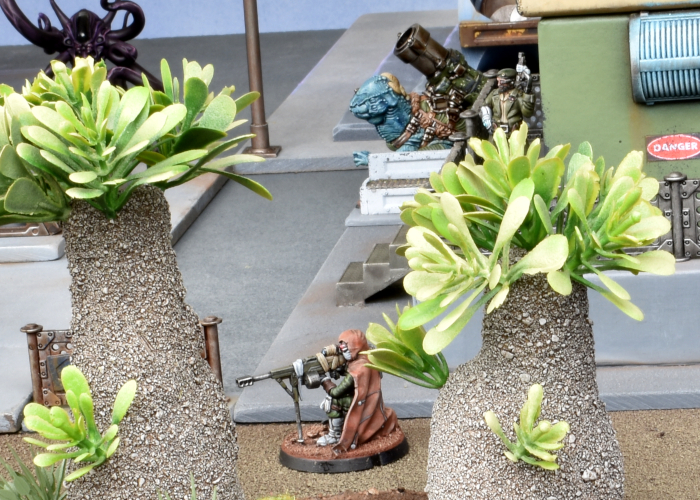
The Spiral Arm Revolutionary Army are a new sub-faction for the Broken. These paramilitary groups tend to be more organised and disciplined than other Broken, and this is reflected in their command structure. Revolutionary Captains stands proudly at the head of their forces, co-ordinating strikes and holding the rabble steady with their iron discipline. While in the shadows, Broken Snipers lurk beneath advanced camouflage cloaks, picking out valuable targets amongst enemy forces.
As an added bonus, this year we also sourced some stock of the plastic gun carriage kit from PDC Gaming. This kit builds a range of variant weapon platforms, and is also a handy source of parts to build an Automated Uplink Relay for Epirian forces, as you can see in this spotlight article here.
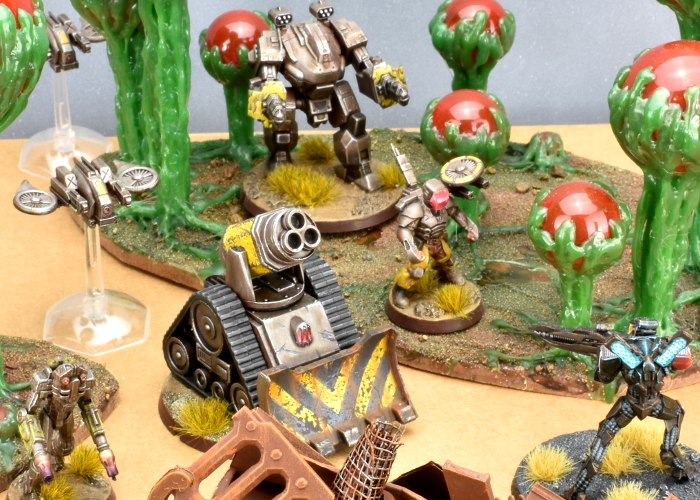
As usual, Iain has been working away on a range of different modeling articles, often using found materials combined with the Maelstrom's Edge terrain sprues, including an energy plant built from a camping lamp, an air conditioner ducting barracks building and a communications relay made from a toy gun! You can find these and the rest of our various modeling articles compiled in the hobby section of the Maelstrom's Edge website here.
Fans on the Comm Guild Facebook group have also been sharing some great projects of their own!
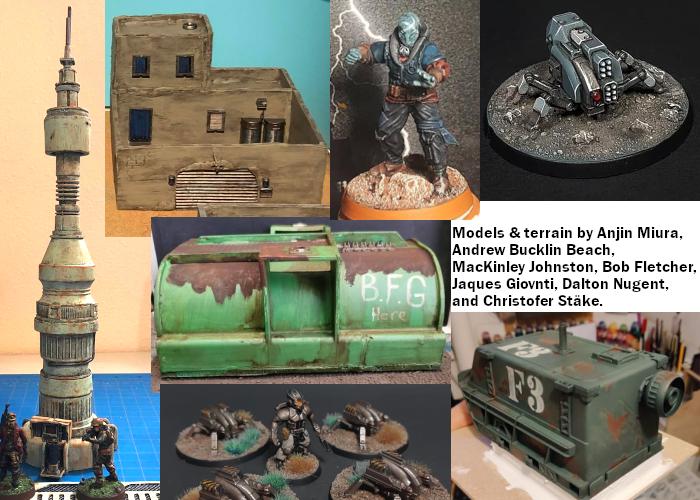
You can check out all of these and more by joining the Comm Guild group here.
For the year to come, we'll be rolling up our sleeves and getting stuck into the second edition of the Maelstrom's Edge rules, with the Beta version of these scheduled for release very soon! Also coming in from the production queue we have some reinforcements for the Artarian Remnant, and that new faction that we've been teasing for a while now...
Stay tuned!
For the full plastic and resin Maelstrom's Edge model range, the ever-useful Maelstrom's Edge Terrain Sprues, novels and audiobooks, check out the webstore here.
For building ideas, modeling tutorials, army spotlights and conversion walkthroughs, have a look at the Hobby section of the Maelstrom's Edge website here.
The Karist, Broken and Epirian factions all received some reinforcements this year. We also saw the end of the Battle for Zycanthus boxed set, as our existing stock sold out. With the second edition of the game on the horizon, rather than producing more of this set, we added some starter bundles and troop bundle deals for each faction to the Maelstrom's Edge webstore.
The Contractor Support Drone added some new equipment options to Epirian forces, allowing Contractors to field Engineer and Medic units and adding sensor drones to Contractor Scouts. This is the last full resin model to be released for Maelstrom's Edge as, with the exception of a couple of upcoming equipment options for the Artarian Remnant, we have now moved completely to plastic for our models.
The Kaddar Alessi Novitiate serves as an alternate command option for Karist forces. Slightly less unhinged than the typical Kaddar Nova, Kaddar Alessi use their charisma and oratory prowess to inspire the forces under their command, or to shake the resolve of any enemy within earshot.
The Spiral Arm Revolutionary Army are a new sub-faction for the Broken. These paramilitary groups tend to be more organised and disciplined than other Broken, and this is reflected in their command structure. Revolutionary Captains stands proudly at the head of their forces, co-ordinating strikes and holding the rabble steady with their iron discipline. While in the shadows, Broken Snipers lurk beneath advanced camouflage cloaks, picking out valuable targets amongst enemy forces.
As an added bonus, this year we also sourced some stock of the plastic gun carriage kit from PDC Gaming. This kit builds a range of variant weapon platforms, and is also a handy source of parts to build an Automated Uplink Relay for Epirian forces, as you can see in this spotlight article here.
As usual, Iain has been working away on a range of different modeling articles, often using found materials combined with the Maelstrom's Edge terrain sprues, including an energy plant built from a camping lamp, an air conditioner ducting barracks building and a communications relay made from a toy gun! You can find these and the rest of our various modeling articles compiled in the hobby section of the Maelstrom's Edge website here.
Fans on the Comm Guild Facebook group have also been sharing some great projects of their own!
You can check out all of these and more by joining the Comm Guild group here.
For the year to come, we'll be rolling up our sleeves and getting stuck into the second edition of the Maelstrom's Edge rules, with the Beta version of these scheduled for release very soon! Also coming in from the production queue we have some reinforcements for the Artarian Remnant, and that new faction that we've been teasing for a while now...
Stay tuned!
For the full plastic and resin Maelstrom's Edge model range, the ever-useful Maelstrom's Edge Terrain Sprues, novels and audiobooks, check out the webstore here.
For building ideas, modeling tutorials, army spotlights and conversion walkthroughs, have a look at the Hobby section of the Maelstrom's Edge website here.
Posted at 05:00pm Dec 14, 2021 by insaniak in General |
Wednesday Dec 08, 2021
Terrain Spotlight: Fruit Jar Air Purifier!
 - by Iain Wilson
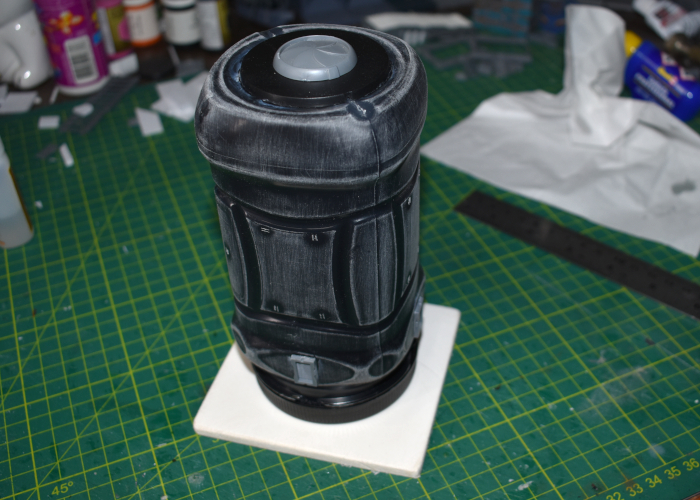
Time for a super-quick terrain build! In the grand tradition of painting things instead of throwing them into the recycling bin, this week I built an air purifier station out of a plastic fruit jar, with some help from the Maelstrom's Edge terrain sprue!
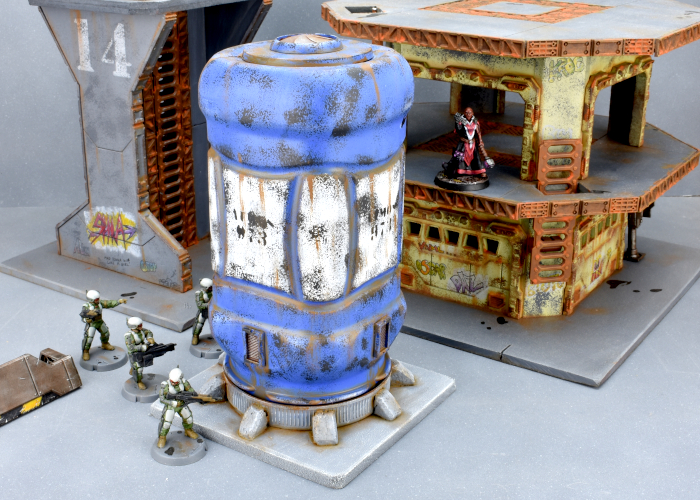
The bulk of this terrain piece uses the aforementioned plastic jar, which I think originally had plums in it. The plums weren't much good for modeling, but the jar itself was an interesting shape, so I figured it was worth hanging onto it.
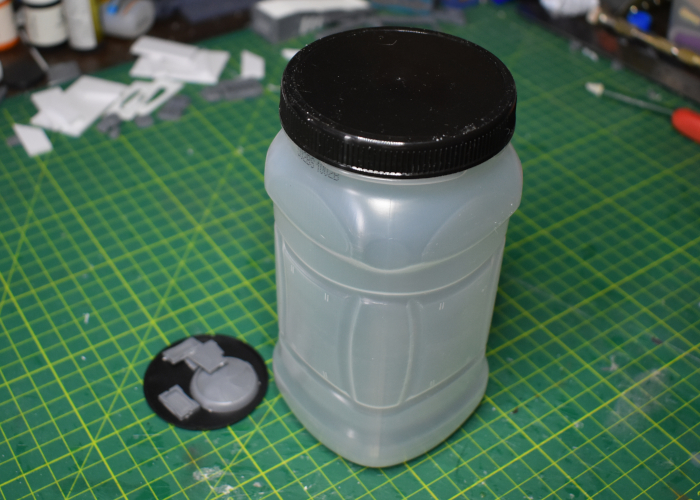
I started out by spraying the inside of the jar with some black paint. This helps to avoid things looking weird if the outer layer of paint gets scratched with use, and also blocks light from showing through if the outer paint layer is thin in places. I also gave the outside a light sand to help the glue and paint to stick better.
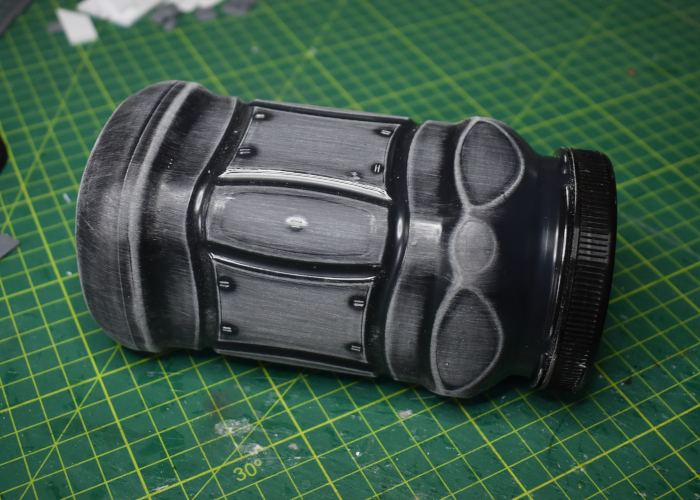
To cover over the embossed logos on the bottom of the jar, I took a large base and cut some indents into the bottom to sit over the mould line on the jar. I glued this in place using some all-plastic glue (a superglue with a primer pen that helps give a secure bond on different types of plastics). In the middle of the base I added an iris portal from the second Maelstrom's Edge terrain sprue.
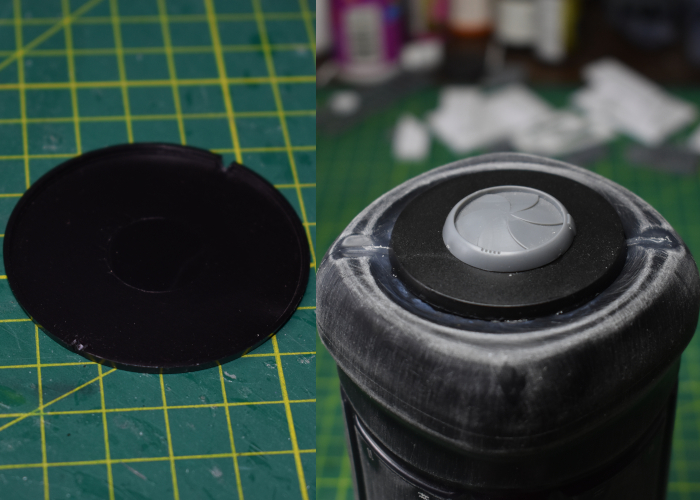
I went light on additional details as I thought the shape of the jar was interesting enough by itself, but I added a vent on each side - the iris on top would be opened to suck in contaminated or otherwise unsuitable air, and the cleaned/chemically altered/now fit for breathing air would be pumped out through the vents, with all of the 'working gubbins' sealed away inside the unit.
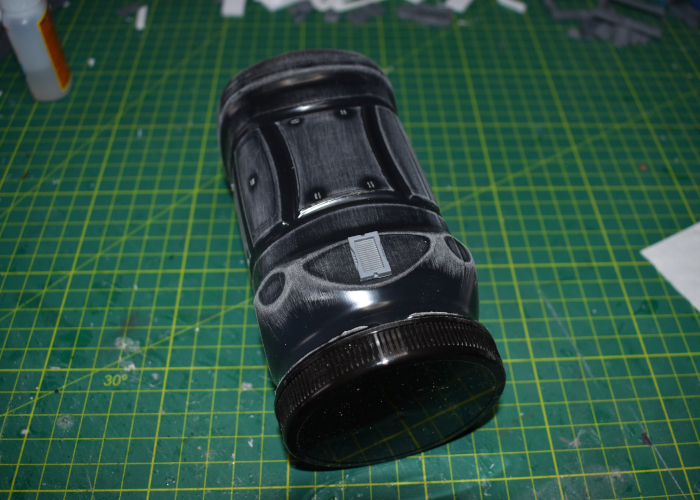
Finally (or so I thought) I added a small base cut from a piece of 5mm foamed PVC.
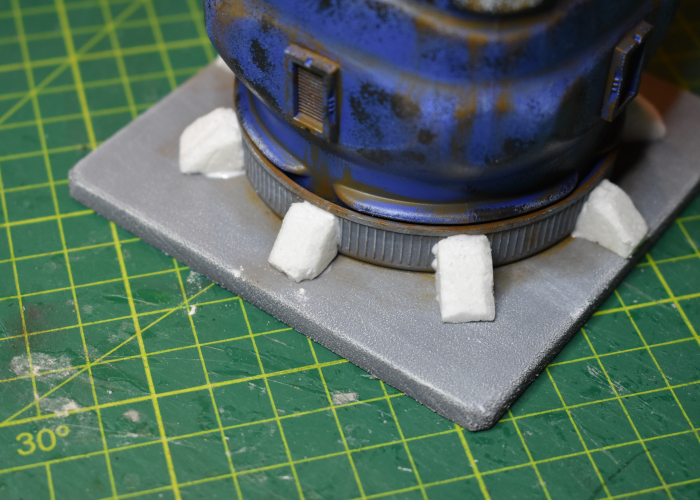
While I was painting the purifier unit, I decided that it still looked a little too much like a jar turned upside down, largely because the lid is such a recognisable shape. So I broke it up a bit by adding some buttresses around it cut from a piece of polystyrene foam.
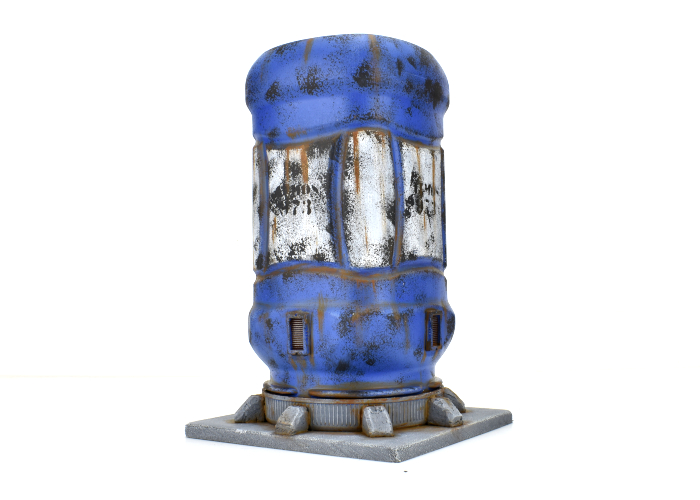
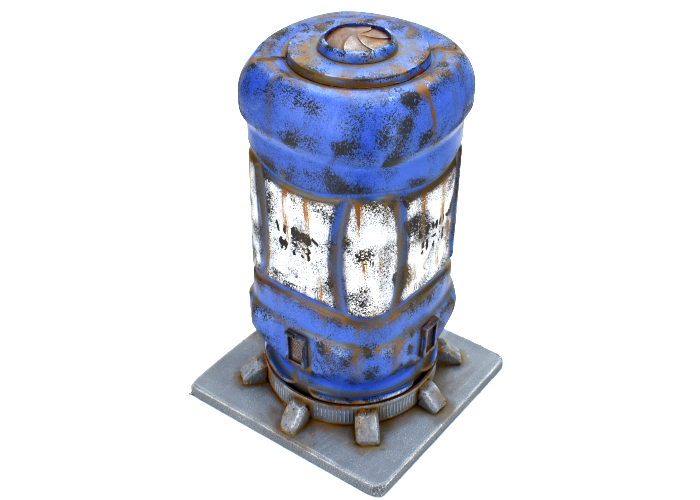
With some paint on, the air purifier wound up looking like this:
Build your own air purifier of respiratory doom by picking up the Maelstrom's Edge terrain sprues along with the rest of the Maelstrom's Edge range from the webstore here.
What are you working on? We would love to see your models and terrain in the Comm Guild Facebook group!
For other building ideas, modeling tutorials, army spotlights and conversion walkthroughs, check out the Hobby section of the Maelstrom's Edge website here.
Posted at 01:03am Dec 08, 2021 by insaniak in Tutorials |